30 Nov 2009

Frozen Ground

CARING for YOUR WINTER GARDEN PART 2
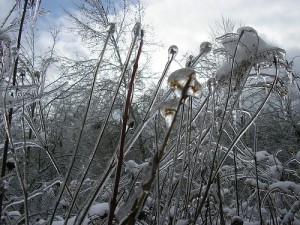
A Frozen Landscape
A Frozen Landscape

It is not necessarily the ice and snow of winter that kills plants.

In fact, snow and ice can act as insulators, protecting plants from wind and sudden temperature drops. More dangerous than the visible signs of winter is something we rarely notice: soggy, poorly drained soil that repeatedly freezes and thaws.

Plants that sit in wet soil can suffer root damage when the ground freezes. Water in the soil turns to ice crystals, injuring and even killing vital root tissue. Hardy plants can recover from dead top growth. Most require nothing more than a hard pruning. But no plant can recover from severe root damage.

How can you prevent the typically soggy Northwest winter from taking a toll on your garden?

It is surprisingly easy. All you need is well drained soil and a layer of mulch.

WELL DRAINED SOIL

How do you turn heavy, Seattle clay into well-drained soil?

  1. Aerate the soil every spring and fall
  2. Add plenty of organic matter

Plants grown in soil rich in organic matter will be healthier, require less water, and usually suffer less insect damage. So what is “organic matter“? Any living thing that you add to your garden is organic matter. As it decomposes, it enriches the soil. Compost, mulch, organic fertizers, minerals, grass clippings, shredded leaves, bark… till it in!

Of course, you won’t turn clay into loam in one season, which is why regular aeration is also important. Aerate and lime your turf areas to improve soil structure. A good organic fertilizer applied in the fall will encourage root growth, rather than top growth. Deep, healthy roots will break up heavy soil.

Never walk on your planting beds, unless you are on a path.

Apply at least a one inch layer of mulch to your flower beds in the fall. Be careful not to press the mulch right up to the stems or to let crater-like pockets form around your plants when the mulch mounds up. You don’t want to trap your plants inside a bowl of freezing water!

Taken together, these steps will pull water down deep into the subsoil where it will not freeze.

This also prevents the phenomena known as “heaving.” As ice forms in the top layer of soil, it expands. This pushes the soil up. If there is a lot of ice, the roots of your plants may be pushed towards – or even above – the surface of the soil. Once again, root damage will kill your garden faster than just the cold.

So remember: the key to winter survival for your garden is a thick layer of organic mulch. Garden bark or compost will protect the soil in the winter and can be turned under in the spring, adding vital organic matter to your garden.

This post was Part 2 of a series.
Part 1: Caring For Your Winter Garden
Part 3: Protect Your Pots

Photo by w.marsh Released under Creative Commons License
28 Nov 2009

Caring for Your Winter Garden

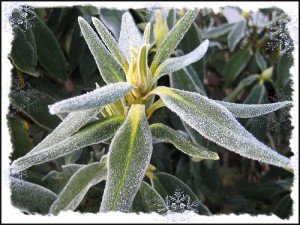
Frost covers a Rhododendron

Winter gardens are common in the Pacific Northwest. Our winters can be so mild that plants seem to grow all year long.

But this is deceptive. Even when we don’t see the heavy and frequent snows of last year, winter poses risks for the garden. In fact, a covering of snow can provide insulation for plants and protect them from freezing.

Frost and sodden ground are the most common plant killers in our region.

The greatest danger to plant survival is a sudden freeze after a warm period. A plant that has not gone dormant has no defenses against winter kill.

We are going to look at ways to protect your outdoor plants and containers from the cold in a series of posts. Today, we’ll talk about frost.

FROST – PRETTY BUT DEADLY

Around Seattle, our first frost usually occurs in early November and our last frost happens in late March. (These dates are only approximate, and there are microclimates all around Puget Sound with different date ranges.) Young, tender plants, growing plants, and new buds are most suceptible to the cold – so you won’t be suprised to learn that the worst frost damage happens to plants in the fall and spring. During the depths of winter, plants are dormant and better able to weather the cold temperatures.

Our almost constant cloud cover throughout the fall and winter helps to moderate temperature swings between day and night and protects our plants. Surprisingly, it is the beautiful clear days, with sunny, blue skies that bring frosty nights.

 There is no way to avoid frost. Even if we could prevent sunny days in winter, we wouldn’t want to! But we can minimize the damage.

  • Frost damages plants by drawing moisture from the leaves to form the ice crystals. Dehydrated plants suffer the most severe injury, so don’t let plants go completely dry during sunny weather.
  • Bare, dry ground loses heat much more quickly than ground covered with mulch. Although our frosts rarely freeze more than the top inch or two of soil, protect your plants’ roots with a good covering of mulch.
  • Do nothing to encourage new growth. Don’t fertilize. Don’t prune plants in the late fall – wait until late spring, when the last killing frost is past.
  • Don’t over-protect your plants. Plants need to be “hardened off” to survive the winter. As temperatures drop and daylength shortens, your plants will slowly go dormant. Don’t interfere with this cycle for cold hardy plants.
  • Container-grown tender perennials can often be over-wintered by placing them in an unheated garage. Remember – you aren’t trying to keep them blooming year round; you just want to protect tender plants from winter kill. Allow them to go dormant, but don’t let the soil dry out completely.

Despite your planning and best efforts, some plants will inevitably suffer frost damage. Sometimes foliage will die back completely. The plant may appear dead, only to push up new growth from the roots in the spring. That is why it is so important to protect the roots from freezing – the topic we will look at next.

This post was Part 1 of a series.
Part 2: Frozen ground
Part 3: Protect Your Pots

Photo by KaCey97007 Released under Creative Commons License
11 Nov 2009

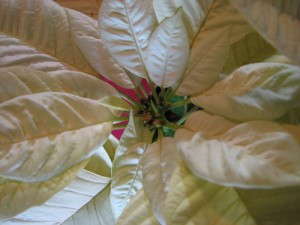
How to Care for Your Poinsettias

Keep Your Poinsettias Looking Their Best

Wouldn’t you like to keep your own Poinsettias at home looking as fresh as they did the day you bought them?

If you ordered your poinsettias for your office or lobby from Plantscapes, our expert technicians will keep them looking fresh throughout the season. They will be happy to share plant care tips with you.

Here are a few Poinsettia Do’s and Don’ts to help you get started at home.

Poinsettias are very sensitive to temperature swings and to drafts. You’ll notice that when your Plantscapes’ Poinsettias are delivered, they’ll be “sleeved,” or wrapped in a paper cone, to protect them. When you purchase Poinsettias for your home, be sure to transport them from store to car to home with the same sort of protection. If the store doesn’t offer sleeving, place the plants in a large shopping bag.

Poinsettias are also fussy about drafts. Never place them in the path of a gust of cold air from a doorway. Keep them away from heating vents. Don’t place them directly in front of cold windows.

Poinsettias don’t like “wet feet.” You should only water them when the soil begins to dry out. If your Poinsettia’s pot is wrapped in colored foil, remove the plant from the decorative wrapping before you water, so that the water has a chance to drain away. Never allow a Poinsettia to remain in standing water.

But be careful – never let your Poinsettia wilt!

Poinsettias don’t like strong light. In the Northwest, with our rainy winter days, this isn’t really a problem. If, however, we have several unusually sunny days and your Poinsettias are in a south facing window, protect them from harsh light during the brightest part of the day.

Don’t fertilize Poinsettias.

Follow these simple Do’s and Don’ts and you will enjoy your poinsettias all season long

DO

  • Protect from drafts
  • Protect from cold
  • Water when the soil is dry to the touch

DON’T

  • Let the pot remain in standing water
  • Carry unprotected plants in your car
  • Fertilize

Photo by LollyKnit Released under Creative Commons License
01 Nov 2009

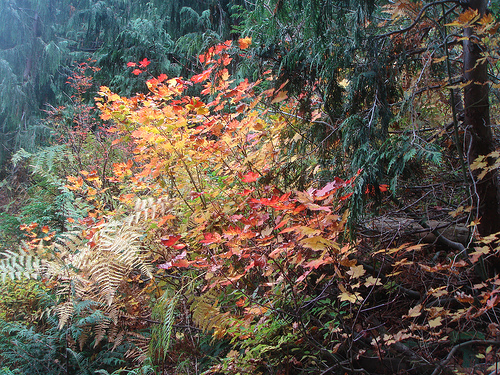
Autumn in the Pacific Northwest

Fall in the Pacific Northwest

Now that temperatures are falling and nights are getting longer, your plants – both indoors and out – will require different care than they received in Spring and Summer.

While indoor plants will not go completely dormant, they will need less water and fertilizer. Your technician will test the soil carefully before watering. It is very easy to overwater in the winter. This, especially when combined with fertilizer, will force plants to continue to grow. Unfortunately, in the low light conditions of a Northwest fall and winter, the growth will be weak and spindly, making your plants prey to all sorts of pests and diseases.

Plantscapes’ technicians will groom your plants and water carefully to encourage compact, healthy foliage.

If you have trouble at home, however, with leggy houseplants, aphids, or mealy bugs, try cutting back on the how much and how often you water. Stop fertilizing entirely until spring. If you aren’t sure how wet – or dry – the soil should be, talk to your Plantscapes’ technician on his or her next visit.  They’ll be happy to advise you.

Outdoor plants may go fully dormant. Turf, for instance, stops growing during the winter. This is the season to encourage deep root growth, not top growth.

Of course, our heavy winter rains make regular irrigation unnecessary. The Plantscapes’ irrigation team will visit your property to turn off your irrigation and to winterize your system. 

Some plants may need to be protected from freezing temperatures. While Plantscapes always selects shrubs and foliage suited to the Northwest, all plants are at risk for root damage in the winter. Variations in temperature can cause the ground to freeze and then thaw. This creates a condition known as “heaving.” If the ground thaws after a hard freeze, it expands. Plants’ roots may be forced closer to the surface by the movement of the earth. There, they may be damaged by the next hard frost.

The best way to protect plants’ root is a good layer of mulch.

If you have plantings in areas that are subject to repeated freezing and thawing, talk to your Customer Service representative about Plantscapes’ bark service. An inch of mulch will protect tender roots in the winter and conserve water in the summer.

Photo by ricardo.martins Released under Creative Commons License