In Praise of Lawns
You might not expect it – but lawns are rife with controversy.
For many, mowing the lawn is a tedious chore. For others, the smell of freshly cut grass is the very essence of summer.
Some people think watering the lawn is a waste of a precious resource. Others can’t image allowing their lush, green turf to go dormant and brown.
Some homeowners douse the grass with weed and feed and keep the blades of grass golf course short. Others swear by slow release organic fertilizers and won’t consider a cut shorter than three inches.
TAKE THE GRASS POP QUIZ
- True or false – lawns are so suburban; xeriscapes are hip and urban.
- What looks better – bluegrass or rye grass?
Did you think there would be a correct answer? Sorry.
Aside from the generally accepted belief that grass is green, almost anything you say about lawns will engender a passionate argument from someone.
LAWN LOVERS TAKE HEART
Whatever your outlook, here are a few facts about lawns that may surprise you:
- A well-cared-for lawns can significantly increase property values.
- A 50-foot by 50-foot lawn produces enough oxygen for a family of four
- Lawns cool the atmosphere.
- Eight healthy front lawns have the cooling effect of 70 tons of air conditioning, which is enough for 16 average homes.
- Grass converts carbon dioxide to oxygen, a process that helps clear the air.
- Dense, healthy grass slows water runoff, removing contaminants, returning fresh, filtered water to the underground water supply
GREEN AND CLEAN
An organically maintained lawn is one of the best ways to care for the environment! You’ll trap greenhouse gases, remove contaminants from the water supply, and lower electricity consumption in the summer.
Here’s the secret to a healthy lawn: rich soil.
Really, there is no mystery to what keeps a lawn green – deep roots in soil rich in organic matter will produce healthy plants, whether those plants are thousands of blades of grass, a few tomato plants, or a dozen rose bushes.
Smothering your lawn in weed and feed kills the micro-organisms that build healthy soil. Dead, compact soil – without worms or other beneficial insects – must be forced, over and over, to push up new growth. The grass in such a lawn is always fragile and in danger of damage from rough use or disease.

But a rich, aerated soil allows the roots to penetrate deeply.
The grass can take up nutrients slowly as minerals and organic matter break down. The soil holds water. The healthy top growth mirrors the vibrant life below the soil surface.
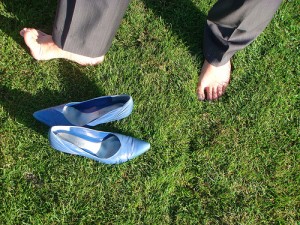
Healthy lawns invite us to kick off our shoes and walk barefoot through the grass. Kids can play, adults can just sit in the sun (or shade) and enjoy the day.
FIVE RULES FOR AN ORGANIC LAWN
1. The first rule of organic lawn care is the world is not divided into grass and weeds. Diversity is healthy. Monocultures are fragile. For instance, clover can be very beneficial when mixed with lawn seed. Clover returns nitrogen to the soil, and it can keep your lawn looking green and lush with minimal care. So don’t reach for the weed killer at the first hint of “weeds” in your grass.
2. The second rule is: pull the dandelions, don’t poison them. Dandelions are so persistent because their tap roots grow deep into the sub soil. If you dig the roots, instead of destroying the top growth, you’ll not only eventually get rid of your dandelions, you’ll aerate your soil.
3. The third rule of organics is the golden rule: add compost. Return nutrients and organic matter back to the soil. If you have a mulching mower, leave the grass clipping on the lawn to decompose. If you rake the clippings up, compost them and then spread the compost in the fall and spring.
4. The fourth rule is feed the roots, not just the tops. Don’t dump pounds and pounds of high nitrogen fertilizer on your grass. Yes, it may make it look greener, but it is a short-lived pleasure. The short top growth of a manicured lawn is mirrored below the soil, where the roots are shallow and thin. Use slow release minerals, like rock dust, greensand, bone meal, granite dust, and rock phosphate to feed the roots. These minerals will last many seasons, building strong roots and healthy soil. Look for slow release, organic sources of nitrogen as well. If you need some instant gratification, an organic tea can do wonders for a lawn in need of a quick pick me up.
5. The fifth rule of organic lawn care is water deeply. Turning on your sprinklers for 15 minutes every day just wastes water. The water thrown into the air will evaporate more quickly. The water on the ground will not have a chance to penetrate and may drift onto sidewalks and gutters. Instead, water early in the morning. Use low rise sprinklers. Monitor run off. Adjust your watering schedule according to the season. Use enough water to penetrate about 6 inches deep into the soil – but don’t water so much that the soil turns muddy and soft.
Barefoot in the Grass by saragoldsmith Photo released under Creative Commons License
Girl in Grass Field by Bill Liao Released under Creative Commons License