By: Tom Walker
When Terry Posner, owner and president of Plantscapes in Seattle first heard that The Highridge Corporation was open for acquisition, he knew this was an opportunity he needed to seriously consider. Highridge has existed since 1985 as a staple in the Seattle area of premier landscape design, construction and maintenance. Plantscape’s roots go back to 1961 but officially began in 1988. They specialize in indoor and outdoor landscape maintenance and installation, seasonal color and holiday displays. The hope of bringing the strengths of these companies together was made reality on June 1st 2012.
Plantscapes purchased from the Highridge Corporation the reoccurring maintenance accounts along with the needed supporting assets. As for the name, it was reregistered as a DBA of Plantscapes Inc. With the majority of Highridge employees moving to Plantscapes with this acquisition the transition for customers has been made as smooth as possible. In addition, Plantscapes is keeping the structure the same for 90 days with an assessment at that point to determine improvements that could be made.
It should be noted that the synergies of these companies is very different. Highridge has worked in a more suburban setting with a main office in Issaquah and a yard close by whereas Plantscapes operates the majority of their business out of an urban area in Seattle with a satellite yard in Everett. This merge was made possible and efficient because Plantscapes was able to move all the administration to their office and adjust crew operation between the Seattle and Everett facilities. This has allowed them to reduce a majority of the overhead while conducting the same operation that Highridge had maintained.
As you can imagine however, bringing together two landscape companies of this magnitude is not an easy task. There are many issues that must be handled carefully and items that must be seamlessly merged. The integration of technologies, account data bases, accounting methods, and phone systems are a few examples. Many of these operational differences revolve around the two operating systems that each company used as Highridge was Macintosh based and Plantscapes is PC/Android based. This affected not only the computers each office used but the method of storing and transferring data and how managers were able to market and create bids.
The overarching goal for Highridge in switching their operating system to Mac was to have managers be completely mobile. This opened up several opportunities for the company. The Macintosh devises Highridge managers used were MacBook’s, iPads and iPhones. Macbooks would generally stay in the office and iPads would be used to write bids in the field and market projects though photos, renderings and designs. One of the main advantages of using these Mac devises was having the ability to store the majority of company documents within the free Apple storage platform called the iCloud. Documents created in the field could then be immediately uploaded and available for everyone to see.
Plantscapes uses a PC/Android based system with traditional server based data storage. They have not yet utilized the Android tablet, the iPad equivalent; however, with the new Highridge employees coming on board with Plantscapes they are testing this possibility. Time will determine which company’s estimating and marketing model and technique makes more sense. The question will be whether account managers will need to access the database and create proposals in the field or if this task can be more efficiently done in the office.
Additionally, the phone system used at Highridge was in line with their model of keeping managers completely mobile. While there was still an office administrator answering phones, these calls were forwarded directly to cell phones instead of desk phones. So whether a manager was in the office, out in the field, or at home, they could still answer.
It has not only been office operations and staff that have had to adjust. Crews have had to learn a new routine of working out of an urban landscape facility where there is less space than the landscape yard that Highridge operated out of in Issaquah. Trucks and trailers are now parked inside of two warehouses where the timing of crews leaving and returning needs to be more precise and phased to keep operations smooth.
While both companies have slightly contrasting landscape backgrounds, because of their mutual focus on maintenance the management structures of these two companies are similar. Generally, in a larger landscape company, the operating model looks something like this: At the top is a business developer who is responsible for selling and generating new accounts for the company. Signed maintenance contracts are in turn handed off to the account managers who are responsible for overseeing a set of accounts and ensuring each client is satisfied. They accomplish this by communicating necessary items to the crew foreman. Because both Highridge and Plantscapes have used variations of this structure this part of the transition has been fairly smooth.
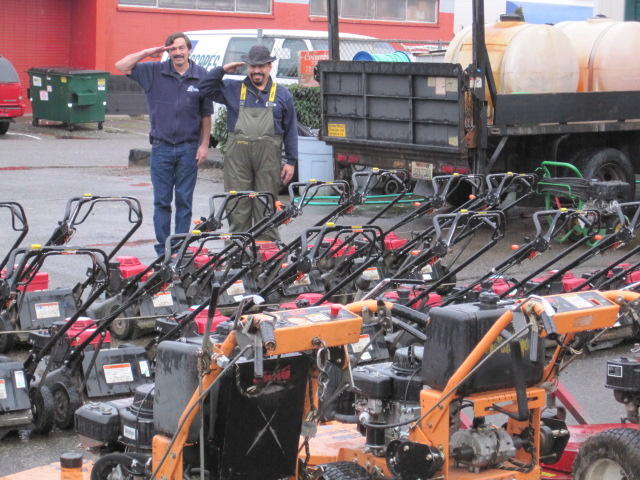
Outside of the systems and operations of both office and field is the transfer of actual physical assets. This has been one of the most involved aspects of this merge. Plantscapes has had to assess and purchase the trucks and machinery they deemed necessary for the merged business to continue to operate. Once it was decided what should be brought over, this process involved a variety of miscellaneous items such as transferring titles, emissions tests and repairs. It also involved reworking the Plantscapes facility to accommodate the new trucks and equipment.
Without a doubt this move has been successful thus far. Management teams are working well together to retain maintenance accounts and acquire new work in the way of maintenance enhancements, residential design build contracts and larger commercial jobs. In addition, crews are learning their new surroundings and routines while still being able to work on many of the same sites they have learned to maintain. The goal of Plantscapes with this merge is to enhance the “Plantscapes” brand throughout the Puget Sound region as a trusted leader in indoor and outdoor landscape design, installation and maintenance.